

Two events. Same ad budget. Same offer.
The first filled a community center room with 8 people. Zero booked a consultation.
The second pulled 50 leads at $8.93 each, 37 people showed up, and 8 booked appointments.
The ads didn't change. The room did.
Most venue advice covers price, parking, and whether the chairs are comfortable. Those things matter. But they don't explain why one room produces appointments and another produces a full house that never books.
Your venue is a targeting decision. It picks your audience before your first ad runs.
The room changes the result before the first ad runs
Attendance and appointments are two different numbers. You can win one and lose the other.
We've watched it happen on one client's calendar. One event drew 42 attendees and produced 1 appointment. An event a few weeks earlier drew 75 attendees and produced 5. A third drew 26 people and booked nothing at all.
Track RSVPs and seats filled, and all three look fine. Two of them lost money.
So when you're judging a room, ask something sharper than "will this fill?" Ask whether the people this room attracts will sit through 45 minutes and then agree to a meeting.
Pick a room for the person you want to meet
Different rooms change who raises their hand. They also change what a registration costs you.
Start with a free meal.
Food fills rooms, and it fills them cheap. For a first event that matters more than anything else, because you need a baseline before you have anything to compare against. A dinner seminar gets you a full room at a lower cost per registrant, and plenty of our clients close well out of those rooms.
Then test against it. A library reads as educational and pulls a different person through the door. One Medicare client compared his results across venue types and moved to a library-only schedule. His read: people who show up at a library came for information. He's building a rotation of three to four branches in his area. A hotel conference room reads as professional and hands you more control over the setup.
If a test beats your meal baseline, do more of that. If it doesn't, you already know what works in your market and you can stop guessing.
Markets differ more than people expect here. The same dinner seminar that fills a room with tire kickers in one county can produce 8 signed deals in the next one over. Run the first event to learn what your market does, then decide.
We don't have a KWD-wide number that says libraries beat hotels or dinners beat libraries. Anyone who claims one is guessing. What we can tell you is that the room shapes your cost per registrant and filters who walks in, so pick it on purpose and then measure it.
One more thing, and it's the part the venue can't fix for you. The room gets people in the door. Everything after that is you: how the event is structured, how clearly you present, whether the audience trusts you and likes you, and whether you make a real ask at the end. We've watched good rooms waste good audiences. Check the presentation before you blame the venue.
Your next venue may be marketing to the same people
This one costs agents money quietly.
Local seminar campaigns run on a tight geographic radius. Ours usually lands around 15 miles, and we move it in real time based on market density and how the campaign is pacing. A rural county needs a wider net. A dense suburb needs a smaller one.
Now picture two venues 8 miles apart. Both sit inside the same radius. That's one audience, reached twice, at full price both times.
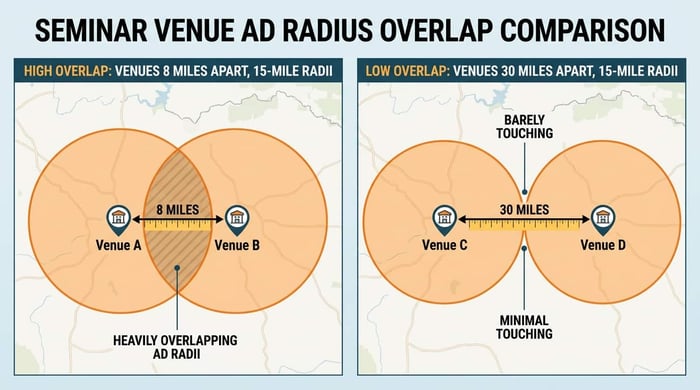
We saw this with an estate planning client whose venues sat 6 and 10 miles apart. The same people kept registering. He asked us to build him a way to block repeat sign-ups.
Repeat registrants cost you twice. Once in ad spend. Again in seats, because every chair one takes is a chair a new prospect doesn't get.
Build a rotation instead of repeating the same room
Three venues works for most people, because most of our clients run one event a month. Three locations carries you through a quarter before you circle back. Run two events a month and you need more rooms than that. Run one a quarter and three lasts you most of a year.
Two rules for the rotation.
First, don't return to the same venue back to back. Give a market roughly 60 days before you come back to it.
Second, space your locations so their ad radii don't stack. Outside the radius is ideal. That isn't always possible, especially in dense metros or small markets with only a handful of usable rooms. Get as much distance as the map allows. Every mile helps.
One Medicare client booked his venues about 15 miles apart specifically to hit different markets. First event under that plan: 23 leads, 18 attendees, 9 appointments.
When a room fails twice, retire it. We credited one estate planning client's event after a second bad turnout at the same community center, and told him to stop booking it. Two strikes is enough data.
Plan the appointment line before the event starts
Your presentation ends. Now what?
In a room that's set up right, people walk to a table and book. In a room that isn't, they walk to the parking lot.
One Medicare event this fall had good numbers on paper: 50 leads, 37 attendees. Then construction noise outside made the room hard to hear in. The space wasn't private. Seating was long banquet tables, so attendees had to climb over each other to reach anybody.
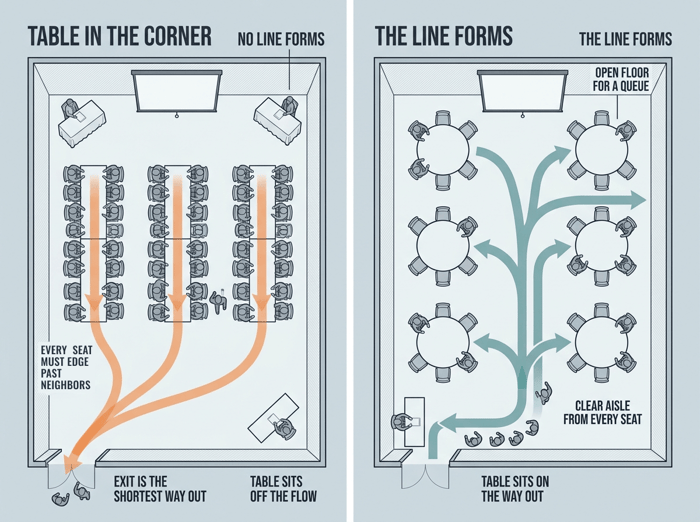
The usual appointment line never formed. The event still produced 8 appointments and 10 requests for a phone call, but the room fought the process the whole way.
Walk the space before you sign. Look for a private room or at least a space with a door. Look at whether the seating lets people stand up and move. Find the spot where a conversation can happen after the talk ends. And check the noise at the same time of day you'll be presenting, not at 9am on a quiet Tuesday.
Capacity is not the number of RSVPs
Registration numbers lie. Everybody knows this, and people still panic at the RSVP count.
One client's room held 40. The cap got set at 30, and ads paused the moment registrations hit it. Final numbers: 25 registrations, 14 attendees, 2 meetings. The room sat two-thirds empty. The ads that could have filled it were already off.
Here's the rule we use. Cap against verbally confirmed attendees, not registrations.
Confirmation calls turn a registration list into a real forecast. Somebody who picks up the phone and says "yes, I'll be there Thursday" is a seat. Somebody who filled out a form three weeks ago is a maybe. Keep the campaign running until your confirmed count approaches the room's actual capacity.
The hidden cost is the work the room creates
Price per hour is the easy number. The labor is what decides whether you can keep doing this every month.
One estate planning client ran community centers because they were cheap. Then he counted what they actually cost him: his team setting up the room, handling food, cleaning up, and packing out. Hours per event, every event, spent on furniture instead of attendees. He moved to testing hotel conference rooms.
A more expensive room that removes four hours of labor can be the cheaper room.
Ask what the venue handles and what lands on you. Setup. Chairs. AV. Food, and whether you're forced to use their catering. Cleanup. Then ask whether you could run that same event twelve times next year without burning out your staff.
The checklist to run before you pay a deposit
- Is there a private room, or at least a space with a door?
- How is the seating laid out, and can people move around?
- What's the real capacity, not the number on the website?
- What AV exists, and what do you have to bring?
- What's the food policy, and what does it actually cost?
- Is parking easy, and is the entrance accessible?
- Who sets up, who cleans up, who handles food?
- How far is this from your last three events?
- Is the surrounding market big enough to support a return visit?
- Where does the appointment conversation physically happen after you finish?
- How loud is it at your presentation time?
If a room fails number 1 or number 10, keep looking. Those two shape your appointment rate more than price does.
Run your venues like a system
Pick the signal. Space the locations. Rotate them. Confirm attendance by phone. Count the labor.
Do that and your seminar calendar stops being a string of one-off gambles.
We run seminar systems like this for Medicare agents, estate planning attorneys, and financial advisors.
Want a second set of eyes on your venue plan? Book a call and we'll map your market with you: how many rooms it supports, how far apart to space them, and where the overlap is.